
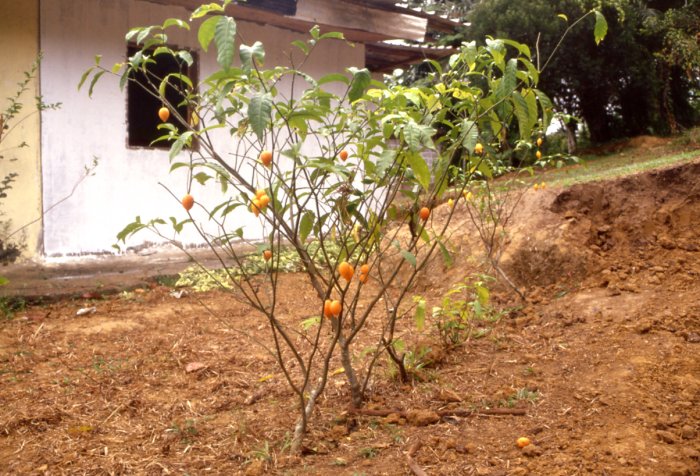
The African Root the West Suddenly Needs:
Ibogaine's Journey from Bwiti Rituals to the Oval Office
On April 17, 2026, an unlikely scene unfolded in the Oval Office. President Donald Trump sat alongside podcaster Joe Rogan and signed an executive order to fast-track the review of psychedelic drugs for mental illness. At the center of this conversation was ibogaine a psychoactive compound derived from a shrub that has grown in the rainforests of West Africa for millennia.
"Joe is an amazing guy," Trump said at the signing. "He wrote me a little note about this, and I had it checked out. Everybody came back with the same answer."
Rogan later revealed the text exchange that sparked it all. He sent the president information about ibogaine's potential to treat opioid addiction and PTSD. Trump's reply was instantaneous: "Sounds great. Do you want FDA approval? Let's do it."
And just like that, with a few text messages and a signature, an ancient African sacrament moved closer to becoming a federally recognized medicine in the United States.
What Nigerians Call It: Names Across Three Major Languages
Before the West gave it a chemical name, before it was called "ibogaine," this sacred root had names across Nigeria's diverse cultures. Here is what it is called in the three major Nigerian languages:
- Yoruba: Ewè Igbà (meaning "forest leaf that heals the spirit") Traditionally used by herbalists for spiritual cleansing and reconnecting lost souls.
- Igbo: Osisi Ncheta (meaning "tree of remembrance" or "memory tree") Believed to help people recall buried traumas and ancestral wisdom.
- Hausa: Koren Tunanin (meaning "green root of deep thought") Used by traditional healers in the north for mental clarity and breaking addiction cycles.
While iboga is more native to Central Africa (Gabon, Cameroon, Congo), related species of the Tabernanthe genus and similar psychoactive roots have been documented in traditional Nigerian medicine for generations. Nigerian healers have long understood what the FDA is only now beginning to study: that certain plants can reset the mind and heal the spirit.
The Latest News: What Just Happened?
Trump's executive order is historic in scope. It directs the FDA to issue "National Priority Vouchers" to psychedelic drugs with Breakthrough Therapy designation, effectively cutting through years of bureaucratic review. More specifically for ibogaine, the order mandates:
- $50 million from the Advanced Research Projects Agency for Health (ARPA-H) to match state investments in psychedelic research
- A new pathway for patients to access ibogaine under the "Right to Try" Act
- Collaboration between the FDA, DEA, and Department of Veterans Affairs to fast-track clinical trials
The FDA is simultaneously taking steps to clear the way for the first-ever human trials of ibogaine on American soil. Previous research stalled for decades due to concerns over the drug's potential to trigger fatal heart problems a legitimate safety issue, but one that advocates argue could be managed with proper protocols.
Marcus Luttrell, the former Navy SEAL whose story inspired the film "Lone Survivor," stood beside Trump during the signing. "You're going to save a lot of lives through it," Luttrell told the president. "It absolutely changed my life for the better."
The African Origins: A Sacred Tradition
Before it was a "promising therapeutic," before it was a Schedule I substance, before Joe Rogan ever uttered its name, iboga was medicine.
The Tabernanthe iboga shrub is native to the rainforests of Gabon, Cameroon, and the Congo Basin. For centuries, the Pygmy peoples and the Bwiti religious tradition have used its root bark in spiritual ceremonies and healing rituals. The word "iboga" itself translates roughly to "to care for" or "to heal" in various tribal dialects of the region.
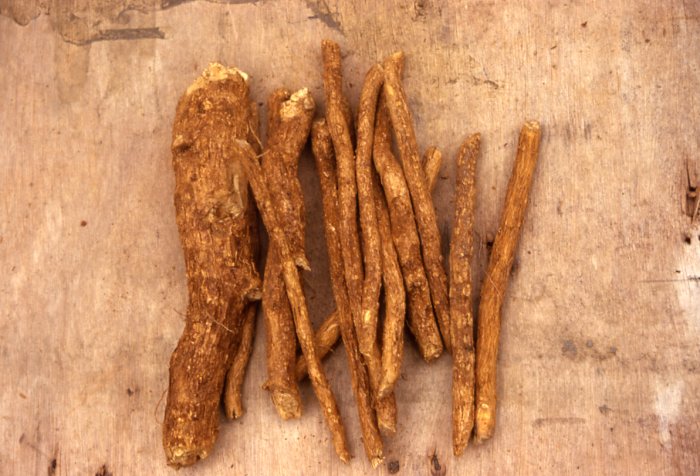
Raw iboga root. The yellow root bark contains the psychoactive compound ibogaine. Image: Useful Tropical Plants Database (CC BY-NC-SA 3.0)
The Bwiti tradition is not merely recreational drug use. It is a sophisticated spiritual system in which iboga serves as what practitioners call the "tree of ancestors" a means of communicating with the spirit world, resolving psychological wounds, and integrating individuals back into their communities.
The ritual is not about escapism but about reconnection to one's lineage, to one's community, and to one's purpose.
When Western researchers first documented ibogaine's ability to interrupt opioid withdrawal in the 1960s, they were, in effect, discovering what Bwiti healers had already known: this plant has the power to reset a broken psyche.
The Paradox: We Don't Value It Until They Approve It
This brings us to the central irony of ibogaine's trajectory.
For decades, the FDA classified ibogaine as a Schedule I substance the most restrictive category reserved for drugs with "no accepted medical use" and a "high potential for abuse". This classification put ibogaine in the same legal box as heroin. Meanwhile, in Gabon, it remained a sacrament, a therapeutic tool, and a cornerstone of cultural identity.
The suppression has historical roots. The FDA has restricted ibogaine since the 1960s, and the DEA further cemented its illegal status in subsequent decades. Christian missionary efforts in Africa actively worked to suppress Bwiti practices, framing ibogaine use as primitive or demonic.
But now that Stanford University has published studies on its effects now that military veterans have testified to its benefits before Congress now that a former president and a podcasting mogul have championed its cause the conversation has shifted.
The Research We Should Be Doing
To be clear: The Western scientific interest in ibogaine is not misplaced. The compound shows genuine promise for some of the most treatment-resistant conditions in psychiatry.
A small Stanford University study published recently followed 30 veterans who received ibogaine treatment combined with magnesium (to reduce cardiac risk) at a clinic in Mexico. The results showed significant improvements in symptoms of traumatic brain injury, PTSD, depression, and anxiety. While the study lacked a placebo control group a limitation its authors acknowledge the magnitude of the effects was striking enough to draw attention from researchers at Johns Hopkins, Harvard, and other major institutions.
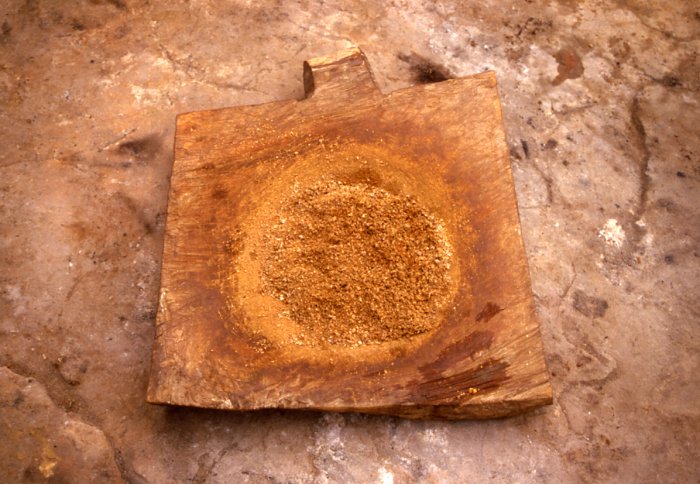
Powdered iboga root bark. This is the traditional preparation used in Bwiti initiation ceremonies and healing rituals. Image: Useful Tropical Plants Database (CC BY-NC-SA 3.0)
Texas has already allocated $50 million to fund clinical research on ibogaine for opioid use disorder. The state's former governor, Rick Perry, has become an unlikely advocate, co-founding a group called Americans for Ibogaine and appearing on Rogan's podcast to make the case for reducing federal restrictions.
Even pharmaceutical companies are taking notice. In 2025, AbbVie acquired rights to an ibogaine analog being developed as a "cardio-safe" alternative acknowledging the parent compound's therapeutic potential while trying to engineer around its risks.
The Heart of the Matter: Safety and Respect
None of this is to dismiss legitimate concerns. Ibogaine carries serious risks. The National Institutes of Health discontinued its ibogaine research funding in the 1990s specifically due to the drug's "cardiovascular toxicity". It can cause irregular heart rhythms and has been linked to more than 30 deaths in the medical literature.
Responsible administration requires cardiac monitoring, electrolyte management, and emergency equipment on hand protocols that clinics in Mexico and Canada have already developed. The FDA's cautious approach has not been without reason.
Conclusion: A Chance to Get It Right
The Trump administration's executive order is not final approval. Ibogaine remains illegal at the federal level. The FDA still needs to review clinical trial data. The safety questions still need answers.
But the trajectory has shifted. For the first time, there is a clear pathway from African rainforest to American pharmacy a pathway that runs through the Oval Office.
As one Johns Hopkins researcher noted, "If the executive order can pave the way for doing objective, scientific research with this compound, it would help us understand whether it is truly a better psychedelic therapy than others."
The question now is whether the West can approach ibogaine with the humility it deserves. Will researchers collaborate with Bwiti practitioners, or will they simply extract the compound and ignore the culture that stewarded it? Will the FDA acknowledge that this is not a "novel" therapy but an ancient one new only to those who were not paying attention?
→ Read more about traditional healing practices
→ Comments are open below
Written by SolFligh
SolFligh Tech Building intelligent, scalable software solutions across web, mobile, automation, and AI systems.
More from SolFligh BlogComments (0)
No comments yet. Be the first to share your thoughts!